
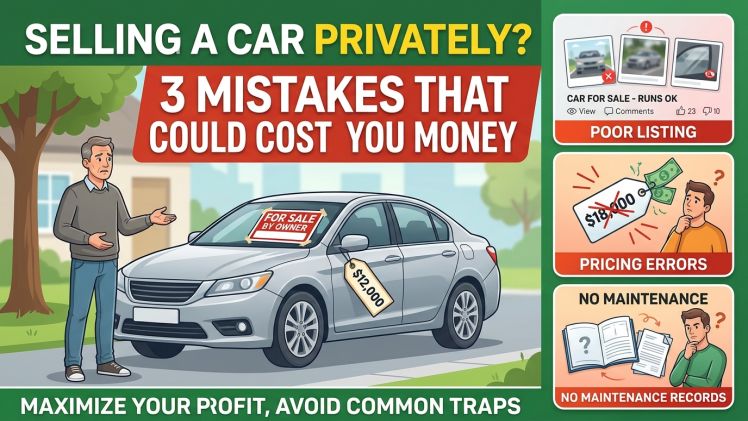
Selling your car privately can get you a better price than a dealership might offer. You get to set the asking price, speak directly with potential buyers, and negotiate a deal that works for you.
But it also comes with more responsibility.
From deciding what your vehicle is worth to handling payments and paperwork, a few seemingly minor mistakes could leave you with less money than expected.
If you’re planning to sell your car yourself, here are three mistakes worth avoiding.
1. Setting the Wrong Asking Price
One of the easiest mistakes to make is guessing how much your car is worth.
Perhaps you’ve seen a similar model advertised for $15,000 and assumed yours should fetch the same. Unfortunately, two vehicles of the same make and model can have very different values.
Mileage, service history, condition, accident records, and optional features can all affect what buyers will pay.
Set your price too high, and your listing might attract very little interest. Set it too low, and you could lose hundreds or even thousands of dollars.
What should you do instead?
Research comparable vehicles on several reputable marketplaces. Look for cars with similar mileage, specs, and condition rather than relying on a single ad.
Remember that advertised prices aren’t necessarily what vehicles eventually sell for.
2. Ignoring Small Problems Before Advertising
That warning light you’ve been meaning to investigate? The scratched bumper you’ve stopped noticing? Potential buyers will probably spot them.
You don’t need to make an older vehicle look brand new, but ignoring relatively inexpensive problems can make it harder to negotiate a fair price.
Buyers may assume that visible issues indicate poor maintenance elsewhere.
Even something as simple as a dirty interior or missing service records can create a negative first impression.
What should you do instead?
Give your vehicle a thorough clean, gather its maintenance records, and consider fixing minor problems where the cost makes financial sense.
Be upfront about any known defects. Honesty can build trust and reduce the likelihood of later disagreements.
3. Overlooking Collection and Transportation Arrangements
You’ve found a buyer, agreed on a price, and arranged payment. Everything seems sorted until you realize the buyer lives several hundred miles away.
Long-distance vehicle sales aren’t unusual, especially when someone is looking for a specific model or car with particular features.
However, unclear collection arrangements can create unnecessary complications.
Who is responsible for transportation costs? When will the vehicle be collected? What happens if the buyer delays collection after payment?
Answer these questions before finalizing the agreement.
For example, buyers who need to transport their car to Philadelphia may prefer arranging professional vehicle transportation rather than traveling across the country themselves.
What should you do instead?
Agree on collection arrangements in writing, confirm who will cover the costs, and independently verify any transportation provider involved.
Most importantly, don’t release your vehicle until you’ve independently confirmed you’ve received the agreed payment.
A Little Preparation Can Protect Your Profit
Selling a car privately doesn’t have to be complicated, but rushing through the process can be expensive.
Researching your vehicle’s value, presenting it properly, agreeing on collection arrangements, and completing the paperwork can all make a difference to the outcome.
It’s also worth remembering that the highest offer isn’t always the best deal. A genuine buyer who communicates clearly and follows through on their commitments may be preferable to someone offering more money but introducing unnecessary complications.
Take your time, ask questions, and make sure you’re comfortable with every stage of the sale.
A little preparation could be the difference between a smooth transaction and an expensive lesson.